
David Baime highlights challenges and opportunities for community colleges in Voices of Impact Speaker Series
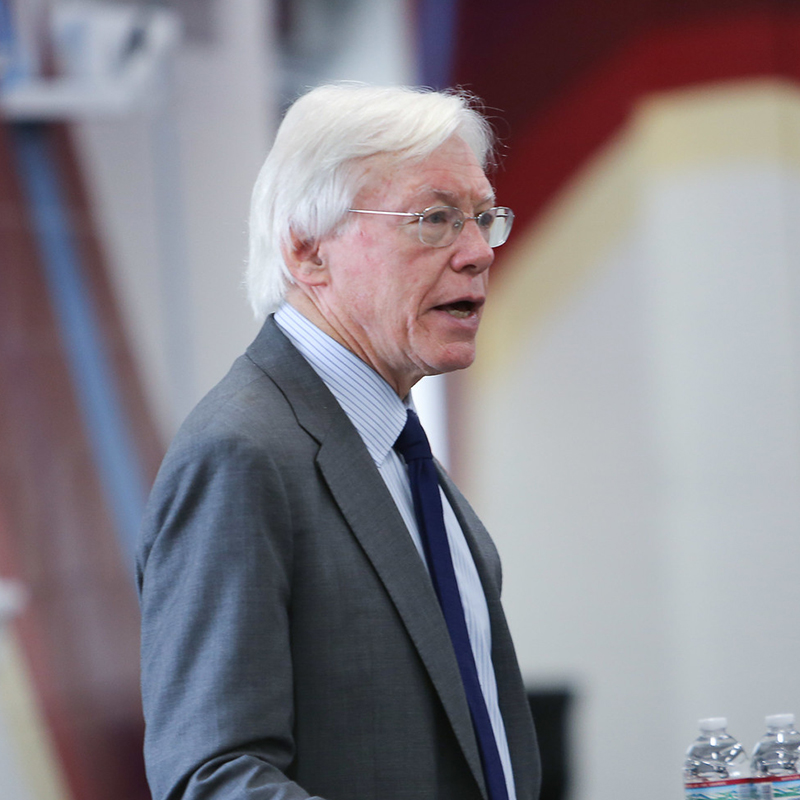 Reynolds Community College recently welcomed national higher education policy expert David Baime, Senior Vice President for Government Relations and Policy Analysis at the American Association of Community Colleges (AACC), as the featured guest in its ongoing Voices of Impact Speaker Series. The session brought faculty, staff, and college leadership together for an in-depth conversation about the rapidly changing national climate for higher education and what those shifts mean for community colleges.
In opening remarks, Reynolds President Dr. Paula Pando underscored why conversations like this matter now more than ever. She noted that developing the talent and leadership capacity within the Reynolds community requires not only skill-building but also a willingness to challenge assumptions, explore differing viewpoints, and understand the broader landscape in which community colleges operate.
“Higher education is in the national spotlight,” Dr. Pando said. “And while we often say that localness is our greatest superpower, the truth is that national policies can shape our work immediately and directly. To lead effectively, we have to understand not just what’s happening here at Reynolds but what’s happening across the country.”
To guide that discussion, Dr. Pando introduced Baime, who has spent decades at the center of federal policy shaping community colleges. At AACC, he oversees national advocacy efforts on behalf of more than 1,000 community colleges and their students. Baime is widely recognized as one of the country’s leading voices on federal higher education policy. He is also a frequent commentator on CNN, Fox News, MSNBC, C-SPAN, NPR, The Chronicle of Higher Education, Inside Higher Ed, and Politico.
Baime began by acknowledging the intensity of the moment. Public confidence in higher education has declined dramatically over the past decade, he said, with students and families increasingly questioning affordability, value, and relevance. That shift is reshaping policy conversations in Washington.
He outlined several broad trends influencing community colleges at the national level. These include shifts in funding priorities, organizational changes within federal agencies, and evolving conversations about long-standing support programs. While these developments may not affect every institution in the same way, together they contribute to a policy environment that feels more complex and less predictable.
The good news, Baime noted, is that Pell Grants and core federal student aid programs remain stable, which is critical for community colleges.
Despite these challenges, Baime emphasized that community colleges continue to benefit from broad bipartisan support. Both Democrats and Republicans recognize the essential role two-year colleges play in workforce development, economic mobility, and community vitality. To sustain that support, he encouraged institutions to clearly communicate their value: strong student outcomes, affordable tuition, small class sizes, faculty-led instruction, and close alignment with industry needs.
He added that students and local business leaders often make the most compelling advocates. Their stories, he said, “place policy in real-world context,” reminding lawmakers of the human impact of their decisions.
A central theme of Baime’s talk was the future of the workforce. The earnings gap between associate-degree holders and bachelor’s-degree holders has grown, he said, underscoring the need for stronger transfer pathways to four-year institutions. While apprenticeships and short-term workforce credentials are gaining national attention—and offer real value—Baime cautioned that they are not one-size-fits-all solutions.
The discussion then shifted to student success and career awareness. Reynolds faculty and staff raised questions about student debt, the role of career services, and the challenge of helping transfer students see clear connections between their coursework and career opportunities. Participants agreed that strengthening advising, expanding partnerships with employers, and helping students articulate their skills will be essential moving forward.
Throughout the conversation, Baime expressed optimism about the future of community colleges—so long as institutions remain adaptable and ready to meet student and workforce needs in real time.
“You’re doing incredibly important work,” he told the Reynolds audience. “Community colleges are uniquely positioned to respond to change. If we stay focused on students, stay connected to employers, and stay engaged in the policy conversation, the future is bright.”
The session ended with even more clarity about the opportunities and challenges ahead—and with renewed commitment among the Reynolds community to lead with both insight and purpose in an era of constant change.
For more on the Voice of Impact Speaker Series, please visit our website.