
“Lead with purpose”: Dr. Falecia Williams inspires others to embrace authentic, courageous leadership
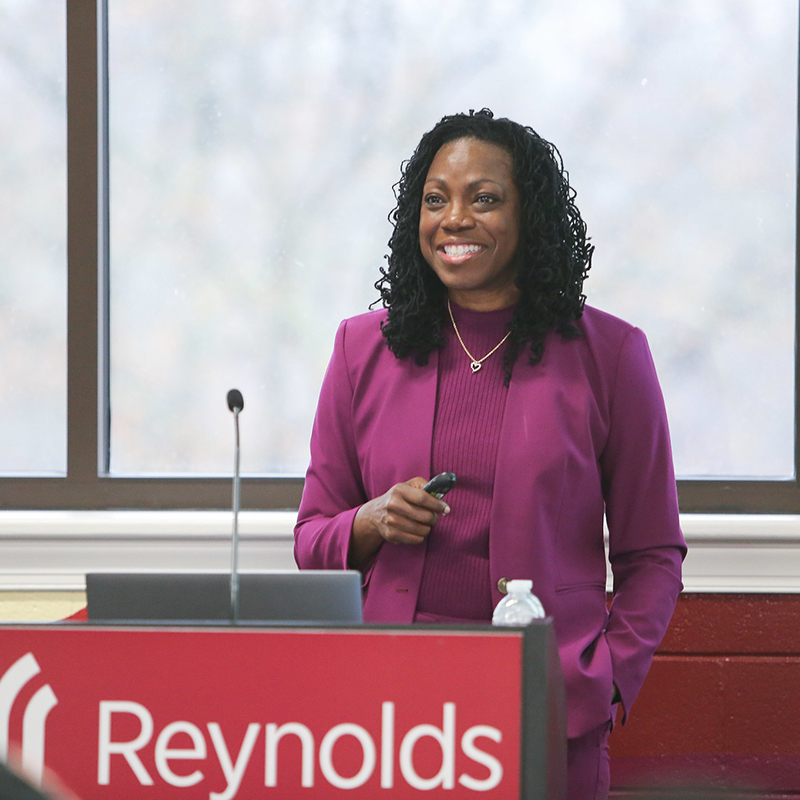 Reynolds Community College welcomed Prince George’s Community College President Dr. Falecia Williams in December for the latest installment of the Voices of Impact Speaker Series. In a compelling and deeply personal talk titled “Leading with Audacity and Clarity,” Dr. Williams challenged faculty and staff to examine the way they show up—as leaders, colleagues, and human beings—and to lead with intention in a rapidly changing higher-education landscape.
Reynolds President Dr. Paula Pando opened the session with a heartfelt introduction. Her remarks set the tone for an hour of candid insight, reflection, and practical guidance on authentic leadership.
Leadership in a Time of Complexity
Dr. Williams began by acknowledging the shifting realities facing community colleges. She noted that enrollment pressures, workforce expectations, and resource constraints demand resilient, adaptable, and purpose-driven leadership.
“Higher education is different now,” she said. “If you remain in this work, you must stand firm. You cannot shrink back or sandbag. You must lead with audacity.”
Owning Your Leadership Presence
A central theme of the session was what Williams called “leadership presence”—the way individuals show up, engage, and influence the environment around them. Presence, she emphasized, is communicated constantly—even in silence.
“Leadership is not only what you say,” she told the audience. “It’s how you enter a room. It’s your tone, your authenticity, your posture. It’s the message you send before you ever speak.”
Williams urged participants to reflect on the unspoken messages they communicate through their everyday behavior.
Small actions—greeting colleagues, making eye contact, showing compassion—shape whether teams feel valued and ready to contribute.
Clarity, Consistency, and Credibility
Clear communication, Williams said, is the “language of leadership.” Without it, people fill gaps with assumptions, leading to frustration, disengagement, or even open resistance.
She reminded attendees that confusion often signals a need for leaders to slow down, explain more clearly, and connect decisions to the institution’s mission and values.
Leaders must “say what they mean and mean what they say,” she emphasized. When teams leave a meeting with multiple interpretations of the same message, trust and credibility erode—what she likened to a workplace version of the “telephone game.”
Williams also highlighted the importance of explaining the why behind decisions. Providing that context builds understanding and momentum.
Authentic Feedback and Healthy Culture
Offering constructive feedback is a critical component of leadership—but it must be done with integrity, respect, and professionalism. Williams encouraged leaders to “praise publicly and correct privately,” sharing an example of a supervisor who issued a public apology after correcting an employee inappropriately. That humility, she noted, strengthened the leader’s credibility.
Negativity, she warned, can spread quickly if left unaddressed. Leaders must confront negative behaviors early, reinforce shared values, and cultivate a culture strong enough to prevent teams from slipping back into old habits. “Culture,” she told the audience, “will always eat strategy for lunch.”
Emotional Intelligence and Leading with Curiosity
Leadership is not defined by a title—it is defined by influence. Williams encouraged the audience to recognize both formal and informal leaders within the organization and to build strong partnerships with both.
She advocated for leading with curiosity rather than assumptions. Asking better questions helps leaders avoid assumptions and encourage collaborative problem-solving.
Balancing Well-Being and Developing Others
To lead effectively, Williams underscored, leaders must also take care of themselves. Boundaries, rest, and intentional pauses are essentials—not luxuries. Sustainable leadership requires the ability to step back, recalibrate, and model healthy work habits.
She closed with a powerful charge: authentic leaders create more leaders. Success, she said, is measured by how many people are empowered to lead because of your guidance.
Before concluding, Williams invited participants to choose one area—presence, communication, curiosity, culture, or well-being—to focus on in the next 30 days. Leadership, she reminded the audience, is an ongoing commitment to growth.
Dr. Williams’ session was part inspiration, part reflection, and part challenge—a timely message for a college community committed to student success and continuous improvement. Through her candor and clarity, she offered a roadmap for leading with purpose.
For more on the Voice of Impact Speaker Series, please visit our website.