
Voices of Impact speaker challenges Reynolds leaders to turn learning into action
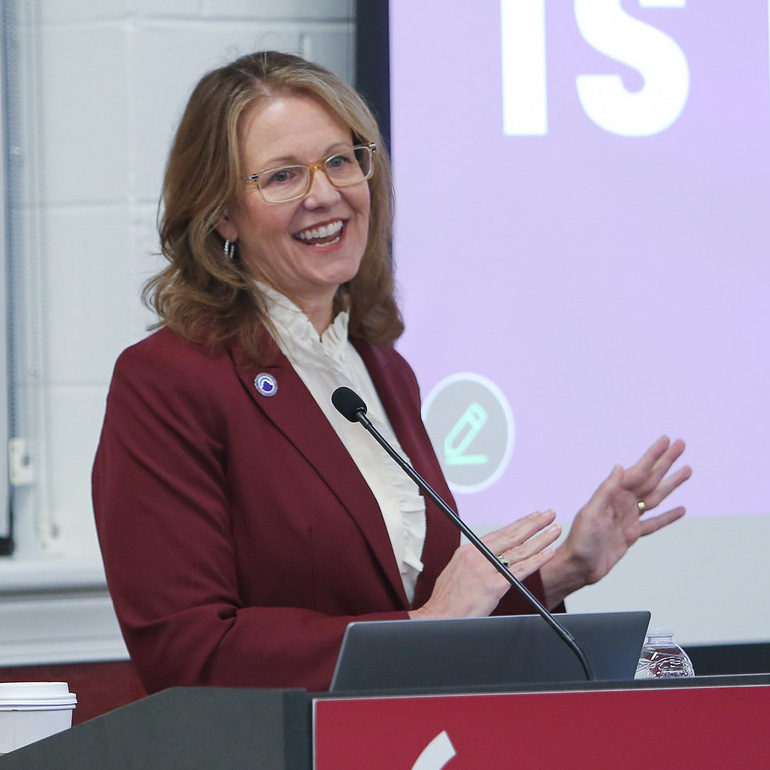 Reynolds Community College recently welcomed higher education leader Dr. Amy Bosley, president of Northwest Vista College in San Antonio, Texas, as the featured speaker for the college’s Voices of Impact Speaker Series on February 20, 2026. Her presentation, Applying Your Learning to Your Leadership: From Learning to Leading, encouraged faculty and staff to translate leadership ideas into concrete actions that improve student success and expand opportunity.
Introduced by Reynolds President Dr. Paula Pando, Bosley opened her remarks by praising Reynolds’ progress and commitment to continuous improvement, noting she has followed the college’s work for nearly a decade.
“You have so much to be proud of here,” Bosley told attendees. “None of it has been easy, and the work you are doing for students and your community truly matters.”
Drawing from her experience leading Northwest Vista College — one of the largest community colleges in Texas, serving more than 22,000 students — Bosley framed leadership as a responsibility rooted not in titles, but in accountability to students.
“Leadership is not about power,” she said. “It’s about making decisions that help students finish, transfer successfully, and earn credentials that change their families’ futures.”
Community colleges as engines of opportunity
Throughout the session, Bosley emphasized the unique role community colleges play in building economic mobility. She described the Alamo Colleges District’s “moonshot” goal of ending intergenerational poverty through education and workforce training, explaining that institutional decisions must ultimately support that mission.
“For many of our students, this is their opportunity,” she said. “There is no backup plan. What we do every day determines whether that opportunity works.”
Bosley urged participants to move beyond attending leadership training and instead focus on applying what they learn. She challenged attendees to identify one change they could implement immediately — whether in the classroom, an office, or a leadership role — that would positively affect students.
“What’s uncommon isn’t attending leadership development,” she said. “What’s uncommon is applying what you learn.”
Aligning actions with priorities
A central theme of the presentation was aligning institutional actions with stated priorities. Bosley encouraged leaders at every level to evaluate whether their time, resources, and decision-making processes reflect what they say matters most.
“If student success is truly the priority, you should see it in your budget, your calendar, and your governance structures,” she said. “Where we spend our time and money tells the real story.”
She emphasized that leadership requires both vision and management working together. Faculty and staff, she noted, can examine their own schedules and workflows to ensure their daily efforts support student engagement and completion.
Turning vision into operational change
Bosley also discussed the importance of translating vision into operational change — often the most challenging part of leadership. Using examples from national student success initiatives such as Unlocking Opportunity, she described how colleges must examine academic programs to ensure they lead to careers that provide family-sustaining wages.
That work, she noted, can require difficult conversations and bold decisions.
“Easy decisions have already been made,” Bosley said. “Now we’re in the work that requires courage — looking honestly at data and asking whether our systems truly serve students.”
She explained that leaders must be willing to navigate risk, disagreement, and discomfort in order to improve outcomes. While institutional change can create tension, avoiding hard conversations ultimately harms students the most.
Leadership at every level
Bosley underscored that leadership exists throughout an institution, not only among senior administrators. Faculty and staff shape opportunity through daily interactions and decisions that can either expand or limit student access and success.
“We stand in the gap between what is and what can be,” she said. “Every decision you make has the power to open doors for students.”
She also highlighted the importance of coaching, delegation, and clear communication as leadership skills that build trust and organizational capacity. Leaders, she said, must model the behaviors they expect from others and ensure their actions align with institutional values.
Closing her remarks, Bosley returned to the urgency of community college work, reminding attendees that meaningful change cannot wait.
“The students in our classrooms today deserve the best we can offer right now,” she said. “Leadership is about being willing to do the hard work — even when it’s uncomfortable — so more students can cross that stage and change their lives forever.”